
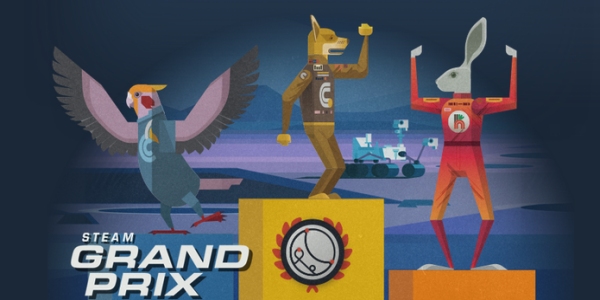
Steam’s summer sale has introduced gamers to a new meta-game that’s themed around a grand prix. You purchase games, rack up points, attempt to boost your team to the finish line, and if you’re successful you can net yourself a free game from your wishlist. Only, things didn’t quite play out that way for thousands of gamers, and it ended up costing indie developers thousands of wishlist removals in the process.
There’s a succinct enough summary of the entire fiasco covered by Inside Gaming, who runs through the controversy step-by-step, as well as Valve’s attempt to salvage the fuddling process to acquire free games from your summer sale purchases.
So the real story here isn’t just the confusion from purchasing games and then not understanding how to boost your team during the meta-game grand prix, it’s that Valve didn’t properly clarify how you would acquire a free game if your team did win. People were under the impression that they would be rewarded a random game from their wishlist, and that wasn’t actually how it was setup, but people went on and removed everything but the game they wanted from their wishlist. This resulted in thousands of people removing lots of games from their wishlist, especially cheap indie titles.
The laments of losing visibility through the wishlist removals could be heard echoing across the Twitter metaverse. This included the founder of Future Friends VG taking Valve to task for the wishlist fiasco, along with No More Robots director Mike Rose, who expressed his lamentations to media, and Paul Kilduff Taylor from Mode 7 Games who tweeted out a graph showing the amount of wishlist deletions taking place during the Steam summer sale.
Hey @steam_games, loads of our indie clients are seeing 1000s of wishlist deletions due to the Steam Grand Prix – any chance you could look into it? Especially for small teams that’s a huge hit to take.
— Thomas.gif 🆗🆒 (@Olima) June 27, 2019
lmao pic.twitter.com/0qn3GIOI09
— Paul Kilduff-Taylor (@mode7games) June 27, 2019
Hey @GreyAlien – Are your games seeing an abnormally high amount of wishlist deletions? I and 4 other devs all are seeing some pretty strange stats. I’ve never once in 5 years seen more deletes than adds/P&A during a seasonal sale. I’ve always left a sale with a net increase. pic.twitter.com/v1OY4MUQW5
— Raymond Doerr (@RaymondDoerr) June 26, 2019
Well, Valve responded to the complaints – especially from the indie developers – in a blog post published on June 27th, 2019.
They explained in the post that they improved the driver’s dash and manual, clarified the rules better, made some backend changes, and helped mitigate some of the problems leading to the confusion, and the hair-pulling, and the general frustrations that have plagued this year’s summer sale. They opened the post with an apology, though, writing…
“We’ve heard your feedback about the complexity of the Steam Grand Prix event. We designed something pretty complicated with a whole bunch of numbers and rules and recognize we should’ve been more clear. We want to apologize for the confusion that this has caused, and also apologize for the broken mechanics that have led to an unbalanced event.”
They also embedded a gif showing how you don’t have to delete all your games from the wishlist and leave only the game you want to earn the free game from your wishlist. You simply have to put the game you want most at the top of your wishlist. They show you how you can drag your wishlist entries around, and move the game you want most to the top of the list, without having to remove the other entries.
The damage was already done for most gamers, and they didn’t seem too thrilled about the whole thing.
Now the second half of Inside Gaming’s video is about Steam’s user engagement numbers dropping. They note that Valve had peaked at around 18 million in October, 2018, according to a report from Statista.
They also note that in the last 48 hours of when they published the video, Valve’s concurrent user engagement numbers were down to 15 million, as noted over on the Steam Charts.
However, this is not an indication of players fleeing Steam, since we have no idea what the last quarter’s averages were.
Is this a seasonal ebb and flow? Was the 18 million an anomaly based on specific offerings and events happening at the time? Are people actually fleeing Steam or are they just bored with PC gaming in general? Are there higher or lower averages during the downtimes between the peaks? What has the buying ratio been from October, 2018 to June, 2019?
It’s easy to look at a peak and a drop-off and scream bloody murder!” but there’s a lot more to it than that. We also have to look at account creations and deletions between this time. How many people made new accounts versus how many accounts were deleted over the last eight months? What are the year-over-year registration figures for Steam? What are the year-over-year account deletion figures for Steam?
Before we can announce “Steam is dying” we first have to look at all of the averages, especially related to user engagement, and then calculate the outcome from there.
People jumping to the conclusion that the Epic Games Store is giving Valve a run for their money is literally based on nothing but propaganda pushed by media outlets.
The reason it’s propaganda is because we have ZERO numbers related to user engagement, client usage, purchase frequency, (honest) sales figures, or quarterly registered users. There’s no way to know if Steam’s drop-off is related to a lack of appeal that gamers have in Steam, or PC gaming in general, or if it actually is the Epic Games Store. A lack of proper figures mean it’s nothing but a shot in the dark in terms of why concurrent usage figures have dropped.
And given that we found out that Epic Games subsidizes sales of unsold copies, it makes it impossible to know if what sales figures that are public are organic or paid for. So regarding “Steam dying!” I would hold off on such drastic conclusions until we have consistent, hard data first.
(Thanks for the news tip johntrine)