
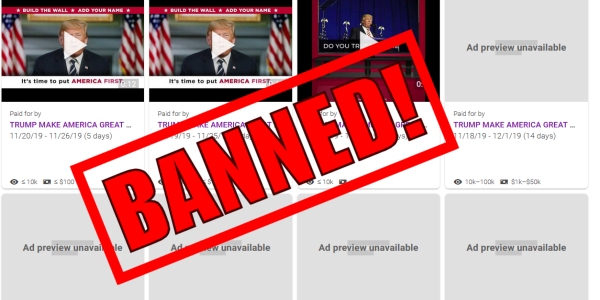
During the 60 Minutes segment that aired on Sunday, December 1st, 2019, it was revealed that Google had banned more than 300 ads for President Trump’s re-election. Why? They said the bans were for violating “company policy”, but didn’t bother to explain how the ads violated their policy.
Axios did a really quick recap of the story, noting that certain Trump ads still haven’t been removed, and also claimed that some of the ads still running across Google and YouTube from Trump are “misleading”, but they don’t exactly point to the ads nor do they bother to fact check or breakdown what part of the ads are untrue.
YouTuber Tim Pool went a bit more in-depth about the issue, pointing out that over the summer that YouTube pulled more than 300 of Donald Trump ads.
Pool points out that while they claimed the ads were taken down for “violating company policy”, we don’t know what policy they violated or how they violated the policy.
This was further corroborated by The Next Web, who took it a step further than what was reported in the 60 Minutes segment on CBS, where – when pressed about the transparency of removing political ads from YouTube – CEO Susan Wojcicki simply stated…
“There are ads of President Trump that were not approved to run on Google or YouTube. […] They’re available in our transparency report.”
The Next Web proceeded to link to the transparency report available over on Google subdomain, where they break down advertising by region and then by committee. You can see that PACs have been heavily advertising for President Donald Trump’s re-election, spending the Trump MAGA Committee has spent close to $10 million in advertising across YouTube and Google.
The problem is that while you can see what ads have run and what ads didn’t, you don’t get to see why.
It would likely require sifting through the CSV and finding the ads that Google blocked and then personally contacting the ad manager at Google to get their take on how the ad violated Google’s company policy… assuming they even respond or are allowed to by the public relations department.
Even though thousands of ads for Trump have been allowed to run on Google and YouTube, the major issue is – as Tim Pool points out – that we don’t have much transparency into why some ads aren’t allowed. What’s more is that it looks especially egregious that Google is controlling what sort of ads you get to see and what ads you don’t get to see based on their own discretion, which looks especially fishy coming off the Project Veritas leak where it was revealed that they intend to rig the 2020 elections so President Trump doesn’t get re-elected.
But it’s not just Trump who is being affected by this.
While there will likely be many delusional people on Twitter cheering on YouTube and Google for removing Trump ads for nebulous reasons, and standing behind Twitter CEO Jack Dorsey for banning all political ads, the major problem is that this has had a bleed-over effect in also censoring certain Democratic candidates as well.
Google’s censorship isn’t just about silencing Conservatives.
Presidential hopeful Tulsi Gabbard went on record during the Joe Rogan Experience to talk about Google’s bias and censorship in trying to upend her candidacy, as well as why she’s suing them for $50 million.
Unfortunately, since YouTube, Google, Twitter, Facebook and the rest of big tech controls what you see, how you see it, when you see it, they control the narrative. So there’s really no escaping from it at this point.
President Trump has mentioned in the past that he was “monitoring” the situation, but time is moving quickly and the 2020 elections are fast approaching, and we’re already seeing these big Left-leaning tech companies making some serious headway in controlling how the elections are presented to the general public in America by controlling the message(s) that the candidates put out.
(Thanks for the news tip MaverickHL)