

While some people aren’t worried about declining birthrates in developed nations, feeling as if a lower population will help with increased productivity, housing availability, and workforce automation, there’s the flipside of the coin where a nation seeing its population continually decline without recourse means that eventually they’ll fade out of existence within a few short centuries. That’s sort the direction that South Korea and Japan are heading in right now if the current trends are sustained.
According to Asia Times, they picked up reports from Japan’s Ministry of Health website that shows birthrates were at 864,000, a record low since the record keeping process started back in 1899.
Newborns reportedly took a dive by 54,000 in 2019 compared to 2018.
So Japan is producing fewer and fewer people each year.
Asia Times notes that deaths were at 1.3 million, resulting in a decline of 512,000 people in 2019.
According to the National Institute of Population and Social Security Research, their population estimations for Japan don’t look good over the next 50-year period. Even on the upper end of the projections they believe that Japan will lose about 27 million residents by 2053. The outcome for the high, medium, and low fertility projections are detailed below…
“Based on the results of the medium-fertility projection, Japan is expected to enter a long period of population decline. The population is expected to decrease to around 110.92 million by 2040, fall below 100 million to 99.24 million by 2053, and drop to 88.08 million by 2065 (see Table 1-1 and Figure 1-1).
“Based on the results of the high-fertility projection, the total population is expected to drop below the 100 million mark to 99.52 million by 2059, and to decrease further to 94.90 million by 2065 (see Table 1-2 and Figure 1-1).
“Conversely, based on the low-fertility projection, the total population is expected to fall below 100 million by 2049 and to decline to 82.13 million by 2065 (see Table 1-3 and Figure 1-1).”
While untrustworthy, CNN did provide a visual forecast of what Japan’s population will look like by 2100, where their population will be a little over 50 million.
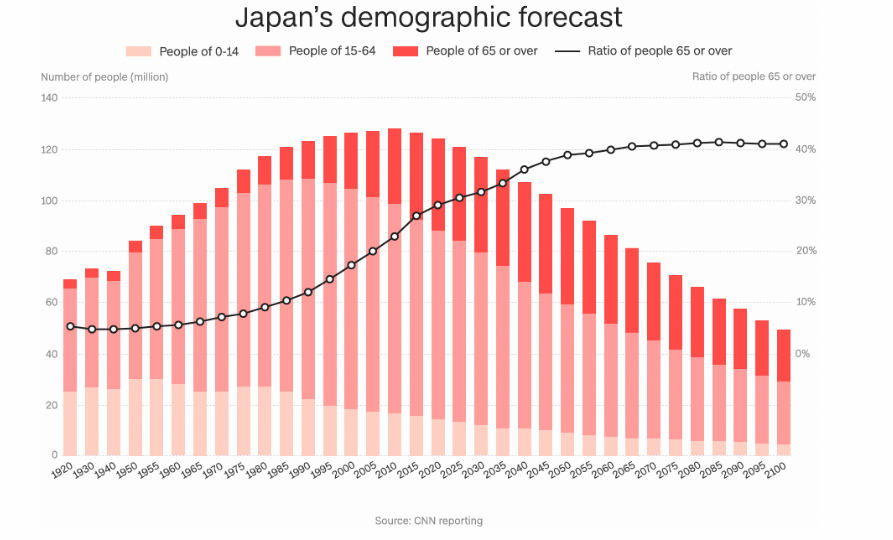
While some people might think this is okay, a question of sustainability arises, and if there is no national course correction, then it’ll continue to decline beyond 2100, leaving Japan an eventual endangered society by 2200 (assuming Earth is still around by that time).
South Korea is also encountering a similar problem. They hit a national low fertility rate of 0.88, and according to JoongAng Daily, while the current population is at 51.7 million in South Korea, they’re expecting a decline to 39 million by 2067, and further declines beyond. Once again, it’s on the verge of possibly joining the endangered nations list.
High suicide rates both in Japan and South Korea don’t help matters at all. However, on the upside Japan has put a lot of effort into suicide prevention, and even managed to bring the numbers down to a record low in 2018, according to Nippon. The main goal isn’t to completely reverse the declining trends, but at least bring it to a slow crawl.
South Korea, however, is seeing a rise in suicide rates among the youth, especially the demographic targeted by the K-Pop culture, as reported by Hankyoreh.
Now Left-wing propagandists will jump to suggesting bringing in low-class, high-crime third-worlders from Africa or India, or even refugees from war-torn Middle-East nations. This would effectively turn Japan and South Korea into war-ridden rape zones like Sweden, Germany, or Britain. Since the Lefties hate progress, cleanliness, and structure, a scenario where immigration increases take place in the aforementioned East Asian countries would be a dream come true for them.
However, a more stable solution would be to give tax benefits to married couples, reduce the overbearing feminist privileges in places like South Korea, reintegrate courses teaching the youth about the importance of masculinity and a patriarchal society headed up by strong-willed, intelligent men, and focus on benefits for local businesses who hire locals instead of foreigners, so there’s greater incentive to reduce the adoption rate of immigration policies.
Putting men back at the forefront of their nations and focusing on healthy households will help stabilize both countries, reduce suicides among young males, and help structure them for a balanced future. Alternatively, if nothing changes over the next two centuries we could be seeing the slow extinction of the higher class East Asian nations.
(Thanks for the news tip anon)