
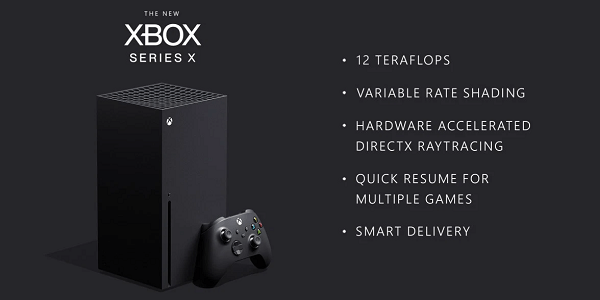
Phil Spencer has taken to the official Xbox blog to inform folks on some of the things powering the forthcoming Xbox Series X. According to the write-up by Spencer, the next-gen console has taken “innovative leaps” when it comes to CPU, GPU, and storage technology so that fans have a “frictionless” and more consistent experience.
That’s right, the next entry in the series of Xbox consoles will release at the end of this year (2020), which means more info on the console as we inch closer to its debut.
With that said, Spencer has taken to news.xbox.com to share what’s powering the next-gen Xbox.
For starters, the Xbox Series X is using AMD’s latest Zen 2 and RDNA 2 architectures. This is said to deliver four times the processing power of an Xbox One (but not the Xbox One X) and enables developers to leverage 12 teraflops of GPU performance:
Next Generation Custom Processor: Xbox Series X is our most powerful console ever powered by our custom designed processor leveraging AMD’s latest Zen 2 and RDNA 2 architectures. Delivering four times the processing power of an Xbox One and enabling developers to leverage 12 TFLOPS of GPU (Graphics Processing Unit) performance – twice that of an Xbox One X and more than eight times the original Xbox One. Xbox Series X delivers a true generational leap in processing and graphics power with cutting edge techniques resulting in higher framerates, larger, more sophisticated game worlds, and an immersive experience unlike anything seen in console gaming.
Variable Rate Shading or VRS is said to help with reducing the amount of GPU cycles spent on every single pixel on the screen so that more work can be prioritized on individual effects on specific game characters or “important” environmental objects:
Variable Rate Shading (VRS): Our patented form of VRS empowers developers to more efficiently utilize the full power of the Xbox Series X. Rather than spending GPU cycles uniformly to every single pixel on the screen, they can prioritize individual effects on specific game characters or important environmental objects. This technique results in more stable frame rates and higher resolution, with no impact on the final image quality.
And it looks like the Xbox Series X will boast hardware-accelerated DirectX Raytracing:
Hardware-accelerated DirectX Raytracing: You can expect more dynamic and realistic environments powered by hardware-accelerated DirectX Raytracing – a first for console gaming. This means true-to-life lighting, accurate reflections and realistic acoustics in real time as you explore the game world.
Spencer also goes on about SSD Storage:
SSD Storage: With our next-generation SSD, nearly every aspect of playing games is improved. Game worlds are larger, more dynamic and load in a flash and fast travel is just that – fast.
The next-gen console will also feature a new thing called “Quick Resume.” This allows players to continue multiple games from any last place almost instantly:
Quick Resume: The new Quick Resume feature lets you continue multiple games from a suspended state almost instantly, returning you to where you were and what you were doing, without waiting through long loading screens.
DLI stands for “Dynamic Latency Input.” This will streamline, or optimize latency in that things are more responsive like connectivity or command response. Additionally, Xbox wireless controllers will benefit from this:
Dynamic Latency Input (DLI): We’re optimizing latency in the player-to-console pipeline starting with our Xbox Wireless Controller, which leverages our high bandwidth, proprietary wireless communication protocol when connected to the console. With Dynamic Latency Input (DLI), a new feature which synchronizes input immediately with what is displayed, controls are even more precise and responsive.
Regarding the Xbox Series X and HDMI 2.1, it is said that the next-gen console can utilize things like Auto Low Latency Mode (ALLM) and Variable Refresh Rate (VRR) to ensure minimal lag and a more responsive experience:
HDMI 2.1 Innovation: We’ve partnered with the HDMI forum and TV manufacturers to enable the best gaming experience through features such as Auto Low Latency Mode (ALLM) and Variable Refresh Rate (VRR). ALLM allows Xbox One and Xbox Series X to automatically set the connected display to its lowest latency mode. VRR synchronizes the display’s refresh rate to the game’s frame rate, maintaining smooth visuals without tearing. Ensuring minimal lag and the most responsive gaming experience.
And of course, if a dev allows for it, you can expect games on the Xbox Series X to reach 120fps:
120 fps Support: With support for up to 120 fps, Xbox Series X allows developers to exceed standard 60 fps output in favor of heightened realism or fast-paced action.
Smart Delivery, according to Spencer, allows a person to buy a game once so that they can play the right version on the Xbox One or Xbox Series X without any problems — when playing the same game on the two different consoles:
Smart Delivery: This technology empowers you to buy a game once and know that – whether you are playing it on Xbox One or Xbox Series X – you are getting the right version of that game on whatever Xbox you’re playing on. We’re making the commitment to use Smart Delivery on all our exclusive Xbox Game Studios titles, including Halo Infinite, ensuring you only have to purchase a title once in order to play the best available version for whichever Xbox console they choose to play on. This technology is available for all developers and publishers, and they can choose to use it for titles that will be release on Xbox One first and come to the Xbox Series X later.
Lastly, the Xbox Series X will release during the late part of Q4 2020 — assuming the coronavirus doesn’t affect shipment, parts, and other plans for launch day.