
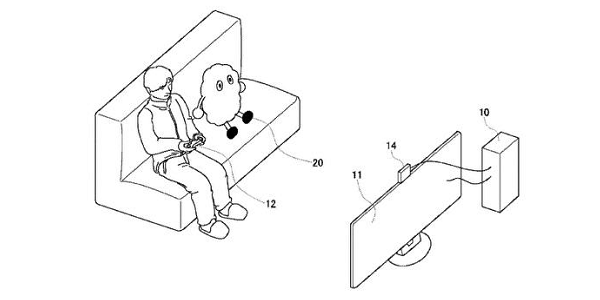
It’s unclear if Sony will ever use this patent submitted in 2018, but what is for certain is that this week the U.S. Patent and Trademark Office is now showing said patent, revealing a “robot” that can sit next to its owner while the person plays video games. Equipped with eyes, hands, and feet, the companion can “talk” to the player as well as “move its arms, legs or neck” in reaction to the player’s emotions.
According to publication site techradar.com, we learn that Sony’s new patent makes mention of the “robot” being “autonomous” to the point where it can sit beside its owner on the sofa on its own terms.
In other words, the “robot” doesn’t have to be placed next to the user — since it can make that decision without any help.
Furthermore, the website highlights that the “robot” can play games with the player, with an example being the companion controlling the opponent team in a baseball game.
We also learn from the patent about the “robot” having a “feeling deduction unit,” which is an object control system that can identify the user’s emotions allowing the companion to “act” on these feelings.
This also means that the unit can assess “feeling-indexes such as joy, anger, love, and surprise” and will be complemented in a way to encourage specific companion behavior via a “biological sensor” that can track the user’s heart or sweat rate.
Instead of writing out the rest of the long-winded patent, a summary of Sony’s patent notes that the “robot’s” existence revolves around a “joint viewing experience” to motivate the owner/player to play “video games.” This is said to compensate for the absence of a “face-to-face relationship with another person.”
In addition to the above, the “robot” will have a “love index,” which can be affected by the owner’s tone and words. This love index also doubles over for charging the companion in that if the owner doesn’t do so quickly, it will react in a similar fashion and estimate that the player “doesn’t love it.” From here, it can also highlight its owner’s “bad habits,” such as not going to bed on time when playing too much of a game.
If it’s “physically harmed” instead of being treated “kindly,” it will no longer “empathize with the player” during a gameplay session. The patent claims this is a “conscious action made to make the user reflect on their attitude” and “treat the robot more kindly in future instances.”
Lastly, Sony also wants to bring this idea to a VR headset. This means that the companion might not be a “robot” but some form of AI assistance in a future release of the company’s VR headset or next product. With that said, here’s an excerpt of the patent that may or may not come to fruition:
“It is expected that the user’s affinity with the robot is increased and motivation for playing a game is enhanced by the robot viewing the gameplay next to the user and being pleased or sad together with the user. Further, regarding not only the game but also a movie, a television program, or the like, it is expected that the user may enjoy content more by viewing the content with the robot as compared to the case of viewing it alone.”