
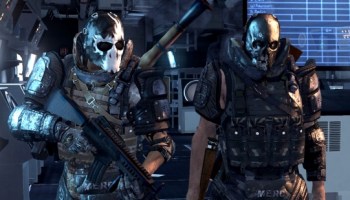
Title: Army of Two
Genre: Third-Person Shooter
Players: 1 – 2 (split-screen or online)
Platforms: Xbox 360, PS3
Developer: EA Montreal
Publisher: Electronic Arts
Release Date: March 4th, 2008
EA Montreal wasn’t always a converged, third-world country-tier development outfit that housed diversity hires and produced useless games that appeal to no one except the Twitterati and mentally ill sycophants. There was a time when Electronic Arts was keen on making games for real gamers, and between 2007 and 2013 they sort of did that. Army of Two was one of their experimental titles that started a short lived franchise throughout the late aughts.
I ended up replaying through the games recently but in backwards order, starting with the sequel, Army of Two: The 40th Day. The game had some highlights but lacked a lot of content and features due to the team starting over from scratch with the assets, which meant that all the character models, weapon meshes, and textures were scrapped from the first one and redid for the sequel with higher quality resolution and more triangles per entity.
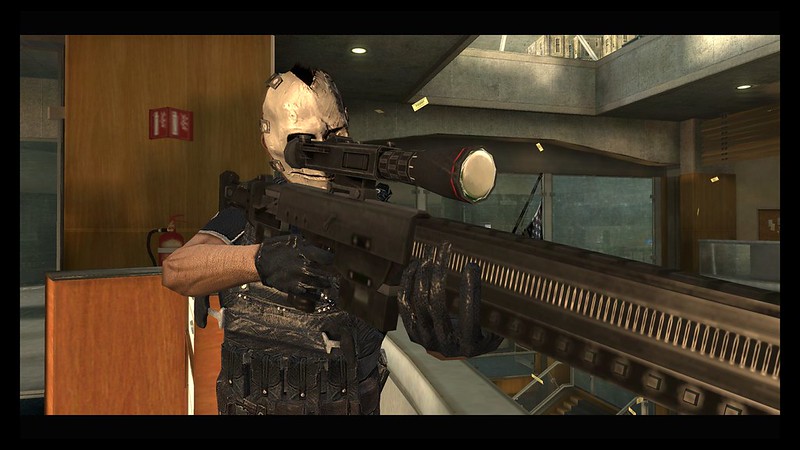
However, The 40th Day was missing a lot of neat features that were present in the original, such as parachuting, dual sniping, more back-to-back segments, vehicles, various side-missions, and a decent selection of side-arms.
Pros:
+More weapons than sequels
+Lots of co-op moments and mechanics
+A few co-op vehicular segments
+Side-objectives
+More tactically grounded story than the sequels
+Large environments for flanking opportunities
+Pozz-Free; no obnoxious POCkers or degenerate propaganda
Cons:
-Not as many customization options as sequels
-Cumbersome controls for weapon switching
-No dedicated melee button
-Lower poly model files for characters, weapons
-Lower quality texture filtering than the sequels
-Voice acting isn’t as good as the sequels
-Averages 30fps
The story for the first Army of Two is a lot more coherent but just as messy as the one from The 40th Day. The game starts with Tyson Rios and Elliot Salem as U.S. Rangers working alongside a private mercenary named Clyde. They help Clyde take out his target and find that they could make a heck of a lot more cash as private mercenaries rather than as soldiers, so they join SSC.
The early goings of the game is a lot more grounded than its sequels, focusing on missions taking place across Africa and Afghanistan, as well as tying some of the missions to real-life events such as 9/11.
The first half of the game keeps the missions reasonable and somewhat realistic, not too dissimilar to Yager’s Spec Ops: The Line< which in some ways seems like the direction they were going with the series, but then the second half of the game gets ridiculous with over-the-top explosions and Michael Bay-esque set pieces, reminiscent to the non-stop carnage and chaos of The 40th Day.
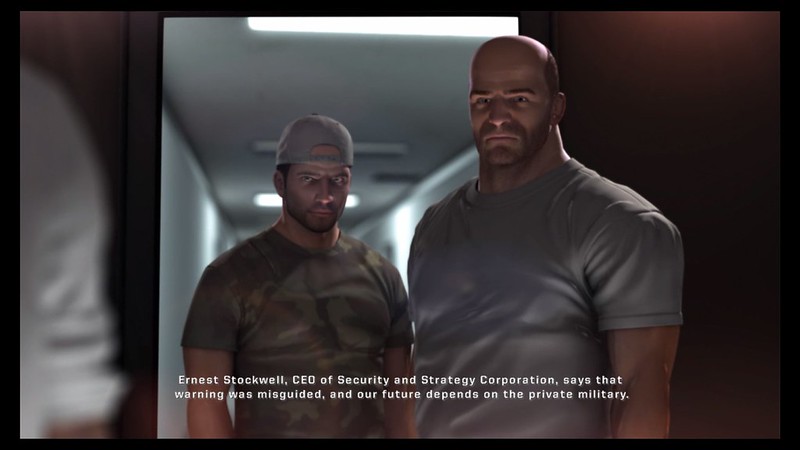
I would have preferred if the game had stayed grounded and kept Rios and Salem moseying around to different war-torn regions across the globe instead of trying to turn them into John McClane and Martin Riggs.
The last half of the game also tries desperately to rush through the story and wrap up any loose ends to bring everything together in a not-so-perfect little package with a bow, even at the expense of playability. For instance, you don’t even get to play the final boss mission, it’s just a cinematic sequence to tidy everything up nice and neat, or something akin to that concept.
Nevertheless, the globetrotting duo earn money for completing main objectives and side-quests, which can then be used to purchase new masks, primary weapons, sidearms, or special weapons.
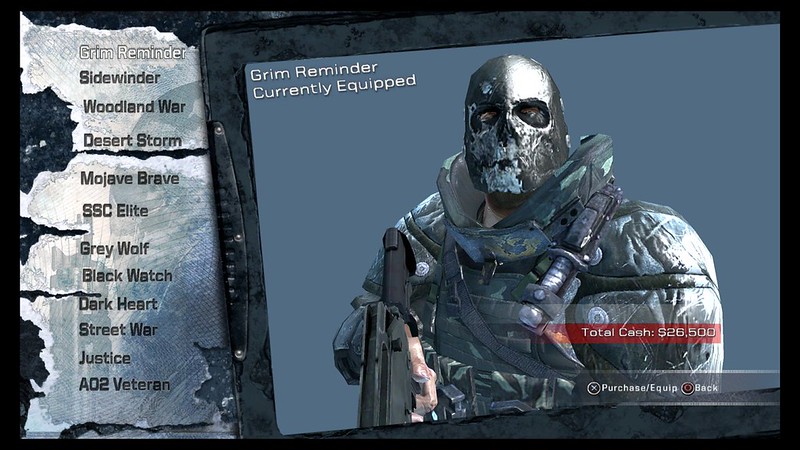
Just like the sequels, you have three weapons you can carry at any single time: primary, secondary, and special.
The weapon selection is slightly more varied than the two sequels, but not by much. It’s bizarre that this short-lived series managed to reduce content with each additional iteration as opposed to improving on the content selection.
While most of the primary weapons stayed the same throughout the series, the sidearms are a lot more robust in the original, including a revolver, 9mm Beretta, and several sub-machine guns.
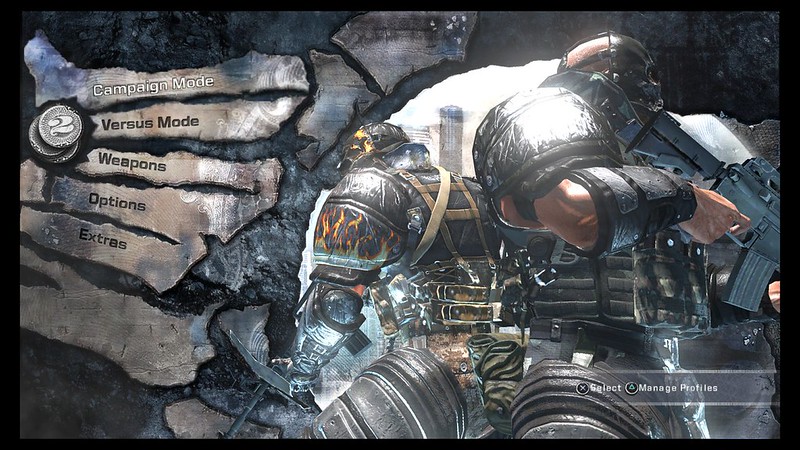
You can customize each weapon, upgrading the barrel, the stock, suppressor, magazine capacity, under-barrel modifications, and selecting whether you want to “pimp” out a weapon or not.
Unlike the sequels you don’t have access to extensive livery customization options, only a single pimped option or not. The pimped versions of the weapons don’t look bad, though, given that they mostly feature specially marked engravings with gold or silver plating and some chrome parts.
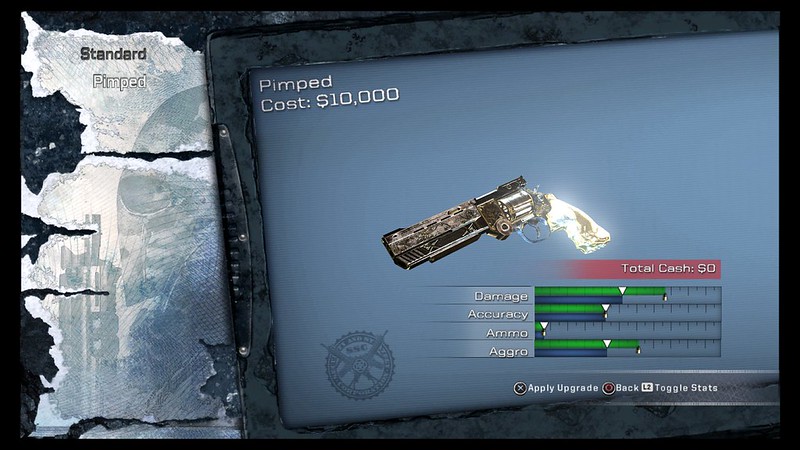
Unfortunately the pimped versions don’t look the same in the customization screen as they do in the actual game, with most of the engravings not being visible or the livery colors being distorted. This is probably one of the biggest differences between the original game and the sequels, because in the sequels how the weapons looked in the customization menu is also how they looked in the actual game.
Another big difference is that all the customization changes are sequential upgrades in the first Army of Two. So each new barrel, magazine, stock, or under-barrel modification must be unlocked sequentially. You can’t just pick or choose what you want and add it to the weapon. So, for instance if you want an under-slung grenade launcher for your Famas or M4, you have to first buy the vertical grip, and then the under-slung shotgun, and then you can purchase the grenade launcher.
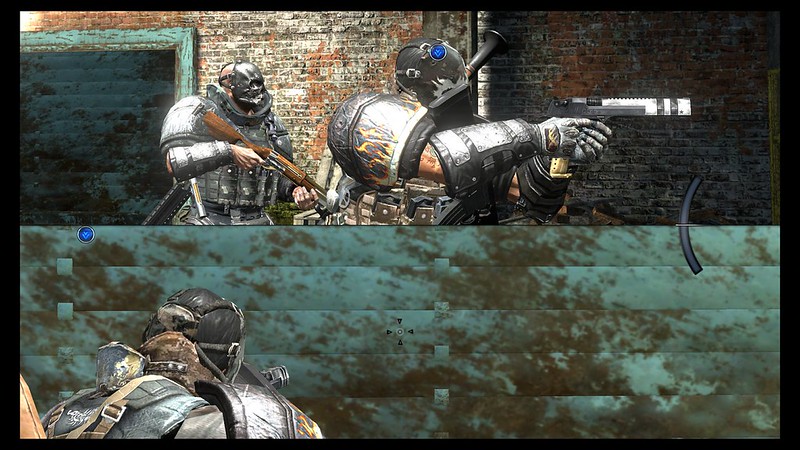
It’s not a deal breaker but it is kind of annoying that you can’t just buy the mod you want without first having to buy unnecessary upgrades for the weapons.
Also, the game features some hidden stats. For instance, the revolver and Desert Eagle’s final barrel upgrades add lots of additional damage output but at the cost of accuracy.
So when you fire you’ll readily miss guys even when they’re right up on you. You can also completely forget about sniping guys at long range when you equip the barrel upgrades for those weapons.
While this might not be much of an issue for some gamers, there’s an added problem: if you run out of ammo in your guns due to the inaccurate barrel upgrades you can’t pick up any other weapons that the enemies drop.
You can give your teammate a weapon, but that doesn’t really solve the lack of ammo problem or the inability to pick up new weapons.
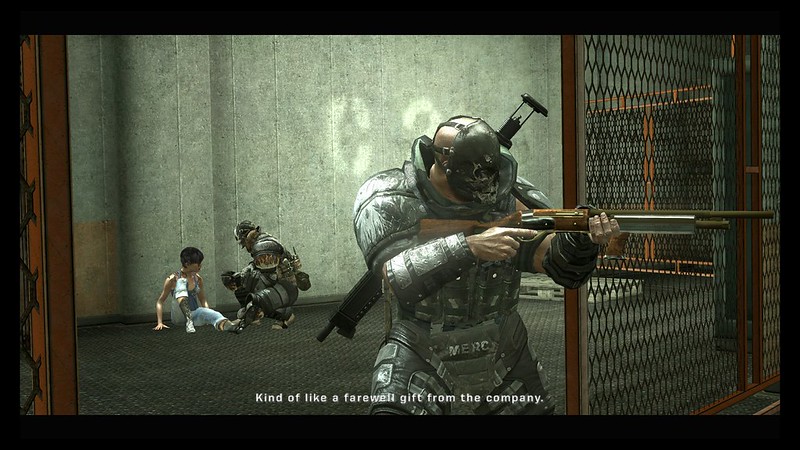
Basically it means that once you run dry, you’re dry and you either have to scavenge for ammo that the enemies dropped, or hope to a pilot on bi-plane over a blue moon that you can pull off the highly unreliable melee attacks to take down foes.
Unlike the sequels, there is no dedicated melee button in the first Army of Two.Your melee shares with your attack button attached to the right trigger. If you tap it while close to an enemy, Salem or Rios will perform a context-sensitive melee attack, ranging from jump-kicking foes to headbutting them to clotheslining them to the ground to elbowing them into the air.
If the melee attacks worked more efficiently and weren’t completely unreliable then they may have been a lot more fun to use, but as it stands it seems like a feature that was tacked on at the twelfth hour and not properly tested.
Sometimes it works, sometimes it doesn’t.
Now most gamers might assume this means that the sequels are automatically better: better customization, better graphics, and more quality of life features.
Well, that’s not really true.
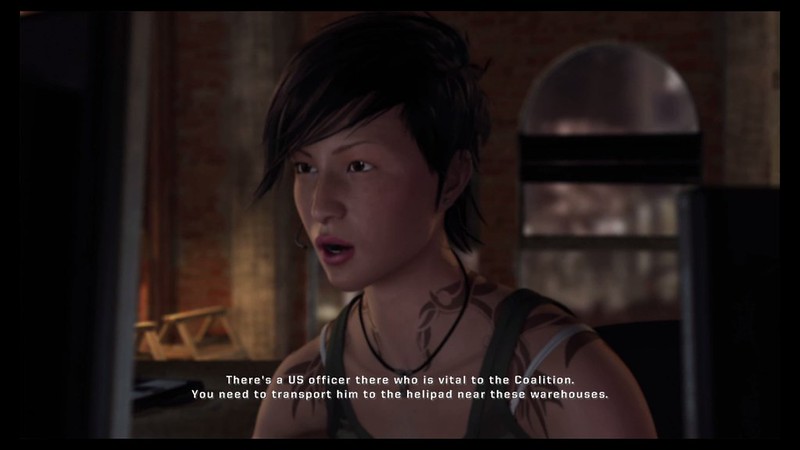
The first Army of Two had subtitles, the second one didn’t. I have no idea why, but it didn’t.
The first Army of Two also had more back-to-back co-op segments where you and your teammate would have to take down just over a handful of foes from all sides in slow-motion. There were well over a handful of times where this mechanic was employed in the first game, but it only showed up twice in the sequel.
The step-up mechanic was also implemented with more tactical finesse in the first game as opposed to the sequel. In the first game you couldn’t just push your teammate up to a ledge and hope everything was okay. Typically you would need to boost them up enough so they could check to see if the area was clear before proceeding, otherwise there were times where you would boost up your teammate only for them to get shot down by enemies standing and waiting for you on the other side of the ledge.
There were also a few other cool co-op features in the first game that were absent from the sequels as well, such as being able to drive around a flooded Miami airport in a hovercraft, or make your way through Chinese rivers and take down your pursuers while one person navigated the rivers while the other manned the turret.
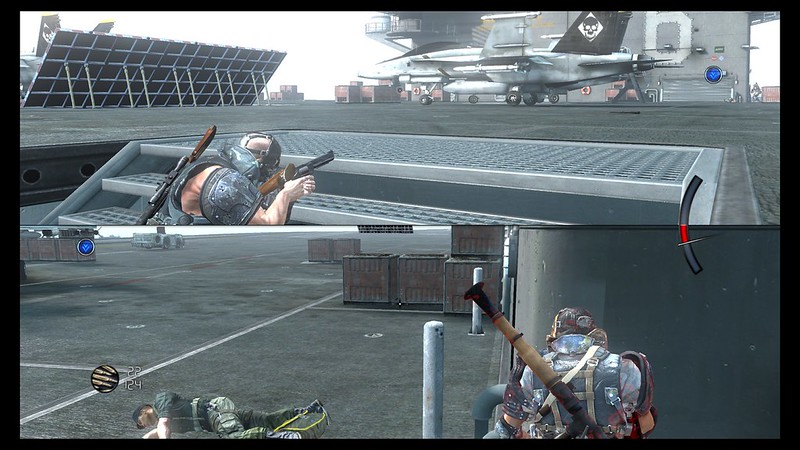
Another neat feature in the first game that was absent in the sequels is the Overkill option. The Army of Two games have an aggro meter that builds up when one player draws the attention of the enemies. If the meter is full then then the player who doesn’t have aggro practically becomes invisible. However, in the first game you can go one step further by activating Overkill if the other player’s aggro meter is maxed out.
Overkill puts the game in slow motion while Rios and Salem briefly have unlimited amounts of ammo in their guns. It gives you an opportunity to blast down any and everyone in sight for a short period of time. You’re not invincible, though, so you still have to exercise some caution.
As far as playability is concerned, the game handles decently enough. There’s no wall-hugging like in the sequels, but you can tap Triangle to quickly move to cover. The shooting works as expected for certain weapons, but you don’t really get to see the gun-porn like in the sequels since the camera is more behind the character’s back, obscuring the weapons in their hand, rather than peering over their shoulder at a slight angle like in The 40th Day and Devil’s Cartel.
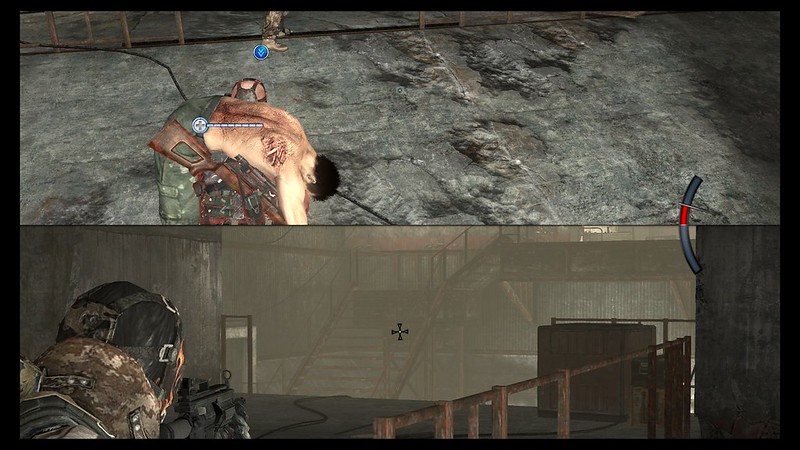
Also, there’s no sprint button, which makes it difficult to navigate some of the maps at times, especially when you have timed objectives to complete.
The inability to swap between a vertical and horizontal split-screen also made things somewhat frustrating when it came to not being able to see certain objects on the ground, such as brief cases or supply crates you could pick up.
I did like the soundtrack to the first Army of Two, though. It had some nice thumping orchestral and tribal pieces to not only match the pace of the combat, but also the exotic locales.
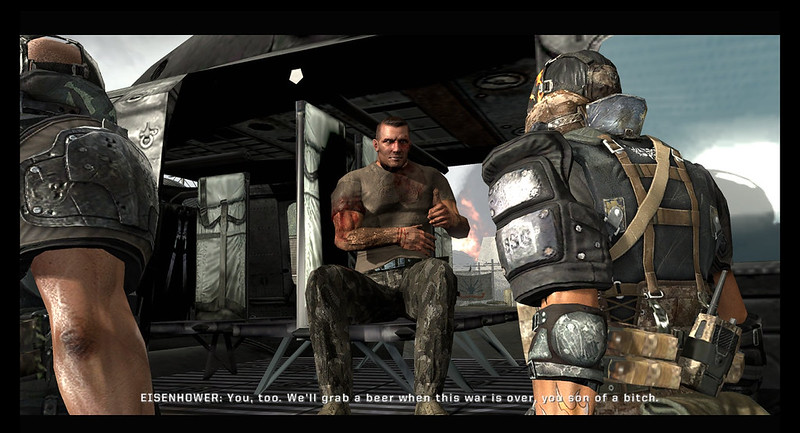
On the other side of the coin, Salem and Rios’ voice-acting was a bit rough here. The 40th Day really shined thanks to Jonathan Adams and Nolan North infusing a lot of character and charisma into the mercenary duo. They had a more friendly but competitive relationship in the sequel, where-as in the first game they were a lot more antagonistic toward one another.
Overall, I would have to say that Army of Two is a game more about gameplay concepts than concrete mechanics. There are some neat features in the game but not all of them work well or work correctly, especially the melee attacks.
The customization is kind of linear and streamlined, and you don’t get as many parts nor the ability to inter-exchange parts between different weapons like in the sequels, but you do get more weapon choices in the first game (which is odd, to say the least).
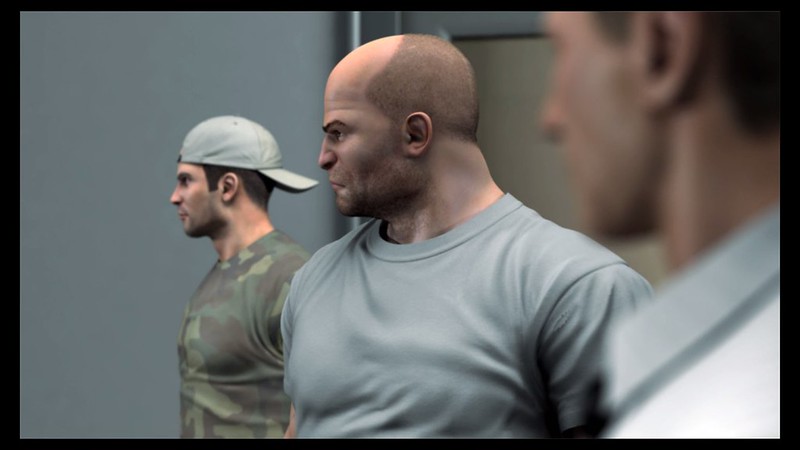
Visually the game isn’t bad, but The 40th Day is still probably the best looking entry in the trilogy. Salem and Rios look like super badasses in that game and they’re far larger than life than in the first entry. The added motion capture for the animations also raised the production values and the presentation appeal for the sequels.
However, the lower fidelity visuals with lower quality texture resolution and lower polygons for the geometry did allow the developers to have larger environments with more routes and opportunities for flanking. The load times were also shorter and less frequent than The 40th Day.
I just wish there was a way to combine all the good parts from each of the games into one proper outing, but that would be expecting too much from EA. And during [current year] I could only imagine Army of Two becoming a woke disasterpiece where the two main characters are hideous lesbians or trans who hate men and constantly opine about oppression, the patriarchy, and white supremacy.
Anyway, if I had to give a verdict for the first Army of Two, I would say to try it. It’s worth playing for the novelty but much like The 40th Day, the replay values are kind of sparse. Although, at least The 40th Day did have the alternate morality path unlockables to collect, which aren’t present in the first game.
Verdict: