
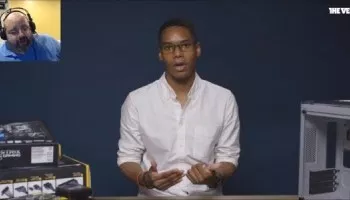
The Verge removed the copyright strikes they filed against the YouTube channels ReviewTechUSA and BitWit on February 13th, 2019. This came after they initially filed the strikes, claiming that the criticisms from those channels on The Verge’s video about how to build a PC were not fair use. Well, The Verge editor-in-chief, Nilay Patel, wrote a blog piece about the incident on February 15th, 2019, defending why the legal team initially had those videos hit with copyright strikes and how people are now harassing them.
Patel completely sidesteps any apology directed toward the YouTube channels ReviewTechUSA or BitWit, and instead explains why the strikes were issued and how he actually agreed with the legal team in stating that the videos were not fair use, writing…
“Those two reaction videos used 90 percent of our footage without any edits, cuts, or otherwise transformative use, and one of them in particular featured what our legal team felt was a pretty racist character. Our legal team felt this was not fair use, and issued a copyright strike request to YouTube for those two videos. A number of other very critical videos were not responded to in any way.
“YouTube notified the two channels in question, said there was a chance our request wouldn’t make it through, and asked our legal team for their case. Our team made the case, YouTube agreed the videos were not fair use, and issued the strikes.
“When this was brought to my attention a few hours later, I told them that although I fully agreed with their legal argument, I did not think we should use copyright strikes against legitimate channels even if we thought the videos crossed the line. (And again, I fully agree with our legal team that these videos crossed the line of fair use.)”
After BitWit and ReviewTechUSA took the issue up with YouTube, the team at YouTube agreed with the content creators and had the videos restored.
Actually, Patel is wrong.
He claims that 90% of the videos were made up of The Verge’s content without edits or transformative use. However, ReviewTechUSA‘s video was actually 34 minutes long while The Verge’s video was around 11 minutes. So it was three times as long as The Verge’s content. You can see the original video for yourself.
The video contains Richard Masucci’s commentary over The Verge’s video while also offering corrections on what they got wrong in building a PC.
Patel also claimed that BitWit’s video was racist, but didn’t exactly explain how. You can view BitWit’s original video below.
Nevertheless, Patel claims that the strikes didn’t seem like a big deal and wrote that the harassment they were getting was “disappointing”…
“One thing I did not do was tweet about it, because I didn’t think the nuance of this situation would lend itself to tweets, and also quite honestly because I didn’t think it was a big deal. There were strikes, and the strikes were retracted. I assumed everyone would move on. […]
“[…] This is all pretty disappointing, especially since I had retracted the strikes and none of the people involved thought it important to simply ask me about it. I hope everyone involved can take a moment and think about making sure they actually know what they think they know, and the value of communicating directly instead of simply reacting.”
While Patel may not have thought it a big deal, as Masucci from ReviewTechUSA points out, a copyright strike is a big deal for a YouTuber because that’s their livelihood at stake. Three strikes and you’re out. Obviously it was something that Patel didn’t consider since it wasn’t his channels at stake.
Additionally, he did go on Twitter to discuss the topic, where he didn’t fare too well against a lot of the criticism aimed at him from a lot of normies after he said that the piece wasn’t published to apologize.
Isn’t an apology.
— nilay patel (@reckless) February 15, 2019
I don’t think anything we’ve done means we deserve a coordinated harassment campaign, and those campaigns delegitimize the criticism. I am firm on that.
— nilay patel (@reckless) February 15, 2019
You didn’t read it.
— nilay patel (@reckless) February 15, 2019
Patel also found himself in an argument over “fair use”, where he claims that he still stuck by the lawyer’s interpretation that the satire from BitWit was not “fair use”.
I mean, I was a copyright attorney. We can go ten rounds on the four factors but the point is our legal team didn’t think these videos met the definition and YouTube agreed. I reversed that decision.
— nilay patel (@reckless) February 15, 2019
To be clear, I didn’t reverse their decision or analysis of fair use, which I still agree with. I reverse their decision to act on it using the YouTube copyright strike system, which everyone agrees is broken.
— nilay patel (@reckless) February 15, 2019
1. Our legal came to conclusion about fair use and submitted a strike. YouTube agreed with that assessment and issued the strike.
2. Separately, I do not think the YouTube strike system is a good way to handle these claims, and reversed the strike.Pretty clear.
— nilay patel (@reckless) February 15, 2019
Patel was bombarded with even more criticisms by users in the Twitter threads.
Others also criticized them for attempting to use “harassment” as a get out of jail card to avoid being taken to task for falsely copyright striking the YouTube videos that pointed out how bad, how wrong, and how misinformative The Verge’s video was for building a PC.
However, The Verge was one of the prime targets of #GamerGate for a reason, being a major outlet that failed to disclose personal relationships, and engaging in calumny to push their own agenda. To their credit, at least The Verge did update their ethics policies back at the start of 2018, but that didn’t seem to have much of an effect on how they deal with copyright striking YouTubers.
(Thanks for the news tip Blaugast)
Loading comments…